

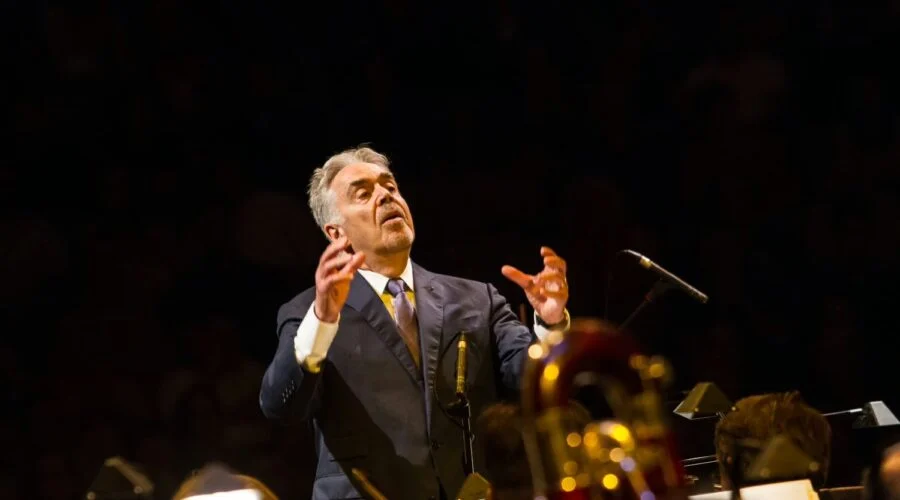
-EAU: During the 70s you were the musical director in Saturday Night Live that last year made 40 years. The musical sketches and the costumes were very important for the program. Could you just tell us how was working with John Belushi, Dan Aykroyd and Gilda Radner?
-Howard Shore: Yes, this period was a group of friends and we began doing shows in Toronto, in Canada, and then we created a new show in New York called Saturday Night Live that run… I did the show from ‘75 to ‘80, but the show’s been on as music director and one of the early creators of the show and now the show has been on over 40 years in American television. It was a very creative, wonderful period to work in.
-EAU: Nice. You composed piano concerts, which the premiere was played by the renowned piano player Lang Lang, and also beautiful cello concerts and Mythic Gardens orchestra. Do you feel comfortable composing music for the concerts hall and which new pieces do you have in mind?
-H.S.: Yes, I’m currently writing a piece for Miloš, it’s a classical guitarist from Montenegro and I’m writing a piece for a classical guitar in orchestra for the National Arts Center Orchestra in Ottawa and the piano concerto for Lang Lang and Sophie Shao was… She commissioned the cello concerto. They were wonderful pieces to work on; each piece of the concerto took about a year to write. They’re coming out on CD; both of the concertos will be released by Sony in February. Recently, there’s a CD called A palace upon the ruins, [you can buy it on iTunes and Amazon , and here are a sneak peek] it will be released on November, 4th and that’s chamber music. It features a song cycle called A palace upon the ruins and there’s performances by Kronos Quartet and Lang Lang. I think I’ve been balancing some of the film music with concert works and it’ a way for me to express other ideas, composition and music that I’m interested in.
-EAU: To do both things. And could you tell us an anecdote of the shooting of your brief appearance as a warrior in Rohan in The Return of the King?
-H.S.: Right, well that was just a costume I was at in a scene. That was an idea of Peter; it was just a fun thing to do.
-EAU: Did you enjoy it?
-H.S.: Yes.
-EAU: How do you feel knowing that the soundtrack of The Lord of the Rings and The Hobbit is loved by millions of fans around the world?
-H.S.: I’m massively delighted. I mean, the Tolkien story is very dear to me and I read The Lord of the Rings in the 60s when I was younger and of course The Hobbit. They’re very precious to me; Tolkien’s lifework is very close to my heart. And I think my love of nature and his love of nature was something, I think, that resonated with me and connected me to his work. I’ve worked now in his world now for many tears, I think maybe 7 years, and very happily and very creatively I think. It allowed me a lot of compositional ideas and music to reflect his words in music.
-EAU: Do you think that this kind of festival, like FIMUCITÉ, that we are in are necessary to spread the word of the movie’s composers and help the public to value the cinema music without the films that they have been in?
-H.S.: Well I think it brings a community together, so I think it’s good for that. People are interested in film and in music and there’s a very good orchestra here in Tenerife, Diego Navarro is a very good conductor. So the works are presented well and it gives the audience a chance to experience the music that they hear in films in the concert hall. It’s healthy, I think.
-EAU: Your relationship with David Cronenberg has offered great soundtracks like The Fly, Eastern Promises, Dead Ringers, among others. Could you tell us how you approach each new work with your friend David Cronenberg?
-H.S.: The work with David Cronenberg has evolved for over 30 years I’ve worked on 15 of his feature films in that time, and because you work with a group like that, there are a lot of the same people behind the camera, a lot of the same filmmakers, that the work of evolves from film to film. You can never really look back, you’re always going forward. David’s a very interesting experimental director when he whishes to be and a lot of the times he’s pushing the envelope into something new. So it’s exciting to work with him and always really creative.
-EAU: Doug Adams published a book, The Music of The Lord of the Rings Films, and now he’s working on The Music of The Hobbit Films. Could you get us a head of something about it?
-H.S.: Well, Doug Adams worked on The Music of The Lord of the Rings trilogy for many years. I think for about 9 years and I gave him access to my archive for many years and I wrote so much music when I was writing The Lord of the Rings and he was able to go through the archive and write this beautiful, cohesive book about my work. I’m thrilled that he did that and he’s now completed or nearly completed a book on The Hobbit source as well. He’s a wonderful writer, he has great detail and his writing is terrific. He’s also written a book on silent film music, over 30 years of silent film, it always had music, because we always think that silent films had not, but it all had music and he wrote a wonderful book on that that’s coming out very soon.
-EAU: Talking about The Fly, as we did before, it’s a soundtrack that has an opera style in the orchestra work like a Puccini drama that you adapted to the stage. How did you manage the challenge of composing your fist opera?
-H.S.: The opera premiered at the Théâtre du Châtelet in Paris and then it went to Los Angeles opera and the piece was created… I think I really had a love for that story when I worked on David Cronenberg’s film, The Fly and I thought it was a good subject for a tragic opera. So I worked on the score, David Henry Hwang wrote the libretto and it’s a beautiful libretto. We worked together, created a new piece to express the story in a new way. It was very exciting and I have a great love of opera so it was wonderful to be able to work on the stage with great singers and a great orchestra. And now I’m approaching a new work, I’m hoping to write on a new work. I have a song cycle to do next year for a symphony but I’m hoping to create a new opera work for the theatre soon.
-EAU: For lots of the fans of music, your composition for The Lord of the Rings and The Hobbit goes beyond the movies, remembering them the Middle-earth created by Tolkien. Was that one of your goals, to get music beyond the movies and to connect them to Tolkien’s work?
-H.S.: I had two great sources to be able to write. I had Tolkien’s great book and I had Peter Jacksons’ wonderful movie, so I had the visualization of the story through Peter’s lands, I had great actors on screen to work with and the Tolkien’s story but I also had Tolkien’s book on my desk all the time, and all the details from the book, So it was really a gift, I had both sources of inspiration.
-EAU: If you had to choose a place to live in Middle-earth, which one will you choose?
-H.S.: I think probably the Shire, I think like most people, the Shire or Rivendell, I guess.